
Bisher Alshehab and Ameer Abedy
“Why do students leave convocations quickly?”
“Why do students hate attending convocations?”
“Why do students want 5 convocations per semester?”
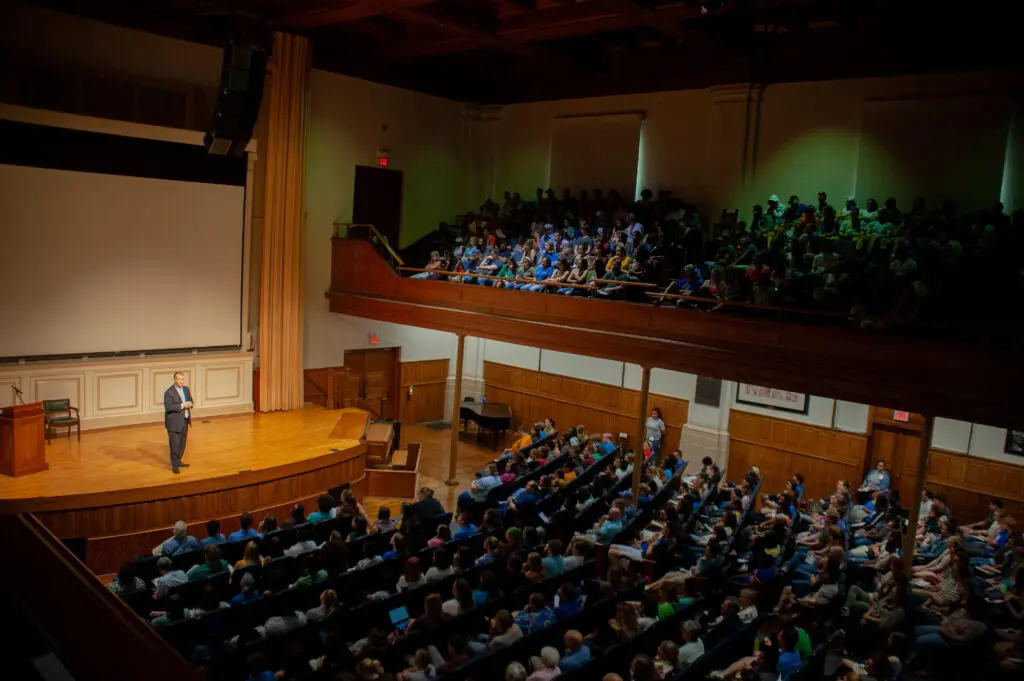
All of these questions are frequently posed by Berea College administrators regarding the status of current convocations. Some say that the current generation of students is unable to focus on an hour-long lecture. Some say students are too impatient. But I think the problem is not with students, but rather a systemic issue with the convocation program itself. Rather than being a tool for intellectual development, Convocations have become a time when students take short naps, finish some homework, or watch a quick episode of their favorite Netflix show.
Since the early 1900s, convocations have been a central part of the college’s history, serving as a large community gathering where students engage with a different speaker each week. Previous speakers have included Carl Sagan, the famous astrophysicist and scientist; Alex Haley, the author of Malcolm X’s autobiography; and Jesse Jackson, the Civil rights activist and Democratic presidential nominee. Speakers of this caliber offer revolutionary ideas that challenge students to reconsider how they approach the world around them.
Looking at the speakers’ roster over the past few semesters reveals a clear pattern. Today’s convocations feel increasingly predictable and risk-averse, often recycling well-worn talking points rather than introducing genuinely challenging perspectives. Some notable examples are the convocation speaker, Dr. Jay Miller, Dean of Social Work at the University of Kentucky, whose remarks focused largely on generic college advice such as basic time management. Another was a presentation by Berea’s mayor, Bruce Fraley, who spent his entire time reading directly off of slides with a tone that laid half the audience soundly asleep.
The last convocation with Basketball coach Steve Ridder was certainly eye catching, but left some students wondering what such a talk was intended to provide in terms of broadening students’ horizons. While such talks may hold practical value for students, they do not reflect the original purpose of convocations: to expose the campus community to bold ideas and thought-provoking perspectives.
It is clear that the convocation committee is pivoting towards lukewarm, safe convocations rather than intellectually challenging ones that may or may not garner negative media attention. While this is a valid concern, Berea’s entire image is built on the fact that it is a school of revolutionaries. John G. Fee was not concerned with public image when he set off to found an interracial college in the antebellum south, at his own peril. Berea must ultimately decide whether preserving rankings and public image is more important than fostering students’ intellectual development. A college cannot claim to champion critical thinking, civic engagement, and academic freedom while simultaneously shielding students from challenging or controversial ideas. True education requires exposure to disagreement, discomfort, and rigorous debate.
By no means is this the fault of any single individual, but rather the result of a broader institutional tendency to prioritize the façade of a “safe” campus over meaningful academic engagement. In doing so, Berea risks abandoning one of its central commitments — a rigorous liberal arts education — in favor of protecting its public image and maintaining its rankings. Berea must not become intoxicated by its 1st place ranking in the Washington Monthly to the point that it forgets its original mission. If convocations are to remain true to their purpose, students and faculty alike must speak up and advocate for a program that embraces diverse, challenging perspectives rather than avoiding them.